One of the biggest misconceptions people have about investigators is that we’re hired to prove someone is lying. The truth is, we’re hired to uncover the facts—wherever those facts may lead.
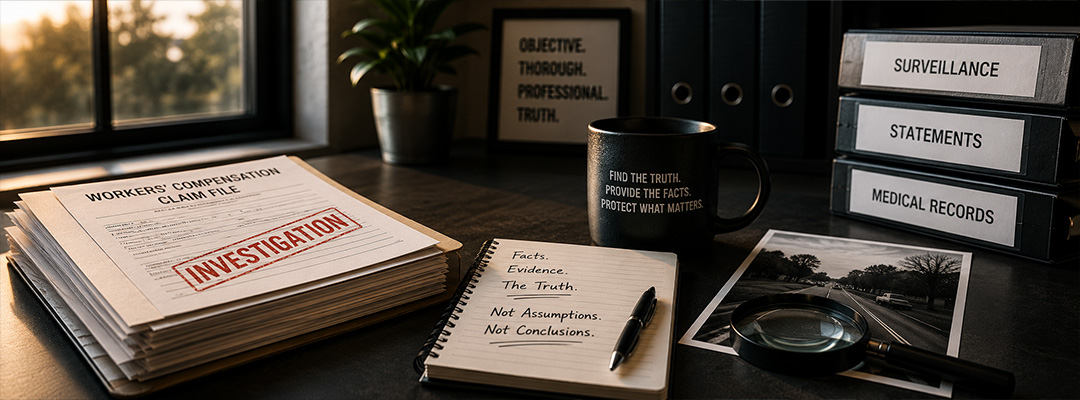
A claims manager contacted Kelley Alliance after receiving a workers’ compensation claim that had raised more than a few eyebrows. The employee had suffered a serious back injury on the job, but as the claim progressed, small inconsistencies began appearing in witness statements and medical records. The insurance carrier wasn’t ready to deny the claim, but they weren’t comfortable approving it without knowing more.
Our assignment wasn’t to prove fraud. It was to determine whether the facts supported the claim.
Over the next several days, I reviewed documentation, spoke with individuals familiar with the incident, and conducted discreet surveillance to better understand the claimant’s daily activities. Like many investigations, nothing stood out immediately. There were no dramatic discoveries or obvious contradictions. In fact, everything I observed seemed remarkably… ordinary.
The claimant moved slowly, favored one side while walking, and appeared to avoid activities that would place additional strain on the injury. There were no afternoons spent playing sports, hauling furniture, or tackling home improvement projects. Instead, I watched someone carefully navigating everyday life while trying to recover from a legitimate injury.
As additional information came together, the inconsistencies that had initially raised concern turned out to have reasonable explanations. One witness had simply remembered the timeline incorrectly. A medical notation that appeared contradictory was the result of a documentation error rather than deception. Piece by piece, the evidence consistently pointed in the same direction.
When I submitted my report, my conclusion surprised the client.
I found no evidence of fraud.
The claim appeared legitimate.
Some people assume that’s a disappointing outcome for an investigator. I see it differently. A successful investigation isn’t measured by how often fraud is uncovered—it’s measured by whether the truth is uncovered. In this case, the facts protected an honest employee from unnecessary suspicion while giving the insurance carrier confidence that the claim had been thoroughly and objectively evaluated.
A few days later, the claims manager thanked us for something I hadn’t expected to hear.
“I’m glad we asked the question,” he said. “Now we know we made the right decision.”
That’s what professional investigations should accomplish. Sometimes they expose fraud. Sometimes they confirm honesty. Either way, our responsibility is the same: follow the evidence, remain objective, and provide our clients with facts they can trust.
At Kelley Alliance, we don’t begin an investigation with a conclusion already in mind. We begin with questions, and we let the evidence provide the answers. Because in our profession, the truth isn’t something you choose—it’s something you discover.