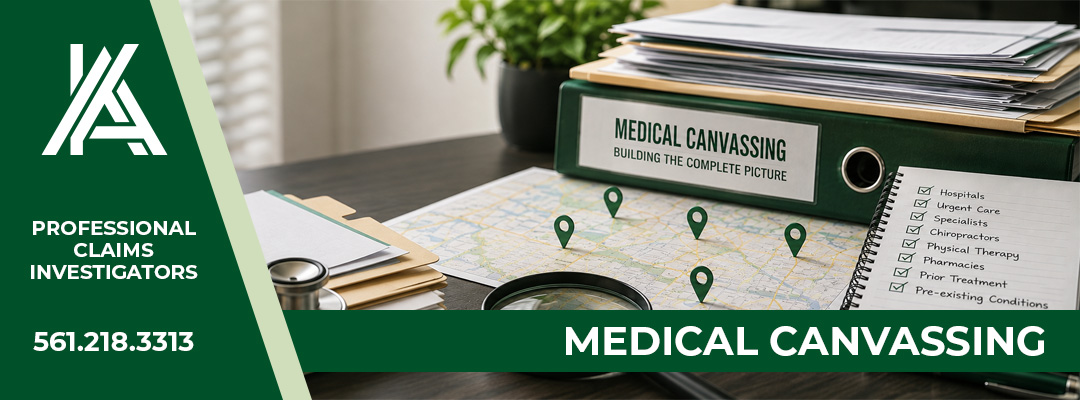
After decades of combined experience in this field, one thing our team can tell you is the file you’re handed is almost never the whole story. You get medical records, an adjuster’s notes, maybe a recorded statement, and you’re expected to make sense of a claim from that. It’s a good starting point. It is almost never the finish line.
That gap is what medical canvassing is built to close.
The idea is simple on paper: go out and identify every healthcare provider who may have treated the claimant, so you end up with a full treatment history instead of the partial one that landed on your desk. In practice, it’s more detective work than paperwork — patience, and knowing which doors to knock on first.
Why We Still Push for This
We’ve had adjusters ask, “Why canvass? We already have the medical records.” Fair question. But the records you have are only the ones you already knew to ask for. Claimants don’t always mention every provider — sometimes it’s an honest oversight, sometimes there’s a prior injury or condition that never made it into the conversation.
A good canvass has turned up things like:
- Prior treatment nobody mentioned that changes the picture on causation
- Symptoms or injuries that don’t line up with what was reported
- A treatment timeline that tells a different story than the claim file does
- Pre-existing conditions that matter when you’re talking apportionment
- Additional providers that open up new lines of investigation
We’ve seen a single overlooked chiropractor visit unravel an entire theory of injury. You only find that by looking.
How It Comes Together
You don’t start by blanketing every provider in the county with letters. Our investigators start with what’s already there — known providers, billing records, pharmacy history — and work outward: hospitals, urgent cares, specialists, chiropractors, physical therapy offices, anywhere near where the claimant lives, works, or where the incident happened.
Some of that legwork goes nowhere, and that’s fine. A dead end in one direction usually points toward where to look next.
Not the Same as Pulling Records
A subpoena or records request only gets you what you already know to ask for. Canvassing is what tells you where to point that request in the first place. Skip it, and you’re only ever confirming what’s already in front of you — never finding what got left out.
At Kelley Alliance, we run medical canvasses across Florida with the same care we bring to every field assignment. This isn’t about catching anyone in something. It’s about making sure a claim decision gets made with the real picture in front of it, not half of one.
A claim decision is only as good as the information it’s built on.