By a Senior Field Investigator, Kelley Alliance
There is a saying among experienced investigators: the accident scene never lies—but it doesn’t volunteer the truth either. Our job is to find it.
Several months ago, I was assigned to investigate what initially appeared to be a straightforward commercial vehicle accident. According to the preliminary reports, liability seemed almost certain. Witness statements were brief, photographs were limited, and everyone involved believed the investigation would be over before it had truly begun.
Fortunately, our client wanted something more than assumptions. They wanted facts.
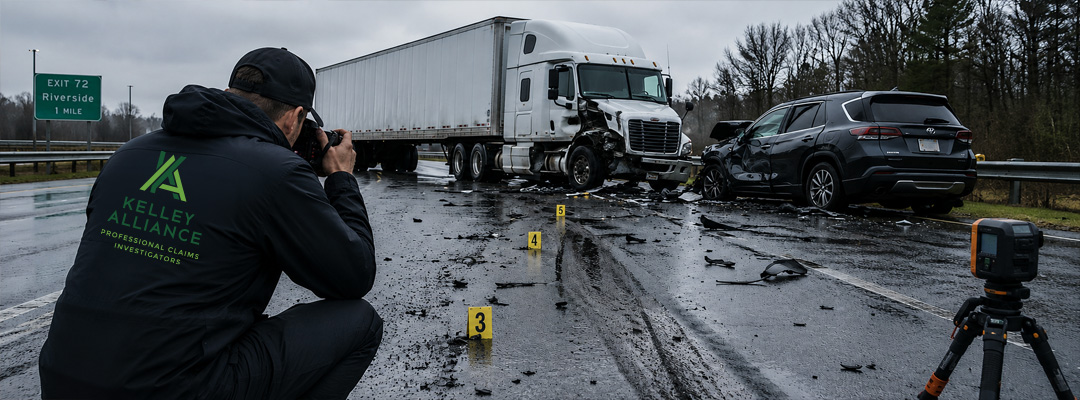
Within hours of receiving the assignment, I arrived at the location to conduct a complete accident scene investigation. Although emergency responders had long since cleared the roadway, the scene was still holding valuable evidence for anyone willing to slow down and look.
What immediately stood out was the pattern of tire marks. They didn’t match the sequence described in the initial statements. Roadway measurements revealed impact angles that were inconsistent with the reported direction of travel. Small debris fields—often overlooked after cleanup operations—helped establish where the actual point of impact occurred rather than where the damaged vehicles ultimately came to rest.
These details may seem insignificant individually, but together they began telling an entirely different story.
As investigators, we document everything. High-resolution photography, precise measurements, roadway conditions, weather data, traffic control devices, sight-distance evaluations, and environmental factors all become pieces of a much larger puzzle. Every photograph has a purpose. Every measurement answers a question. Every observation may become important months later if litigation follows.
Back at the office, those field observations were compared against vehicle damage, witness interviews, available surveillance footage, and official reports. One inconsistency led to another.
Eventually, the reconstructed timeline demonstrated that the sequence of events could not have occurred exactly as originally reported. Additional evidence confirmed that a contributing factor had been overlooked during the initial response. Once all of the facts were assembled, liability shifted significantly from the original assumptions.
For our client, that meant making decisions based on evidence rather than speculation.
That outcome is one of the reasons accident scene investigations remain one of the most valuable services available to insurance carriers, self-insured organizations, municipalities, legal professionals, and risk managers. Physical evidence begins disappearing almost immediately after an incident occurs. Tire marks fade. Debris is removed. Weather changes roadway conditions. Vehicles are repaired or salvaged. Memories become less reliable with each passing day.
Time is often the greatest enemy of an accurate investigation.
Experienced investigators understand that accident reconstruction doesn’t begin with software—it begins with careful observation. Long before reports are written or diagrams are produced, someone has to walk the roadway, evaluate the environment, identify evidence, and ask the questions others may not have considered.
At Kelley Alliance, our investigators approach every assignment with that mindset. We don’t arrive looking to support one version of events or another. We arrive looking for facts. Whether we’re investigating a vehicle collision, commercial transportation incident, workplace accident, or premises-related event, our objective remains the same: preserve evidence, document conditions accurately, and provide our clients with reliable, objective information they can trust.